
Topics for discussion:
- Does your language distinguish between craft and art, or is there one term for both?
- Is it important to have one common European definition of crafts? Why?
- Could defining craft at the European level lead to the loss of unique local traditions?
- How can family transmission of craft skills be supported at the regional or national level?
In October 2023, PIOP and ARMINES interviewed Yiannis and Dimitris Hondrogiannis as part of the CRAEFT Ethnographic Protocol. The interview aimed to learn the marble carvers, their craft, and to identify the gestures to be recorded later that fall. Part of the interview was to find out which are the stages of the marble carver profession, that is, who their clients are, where they find raw materials, which processes take place, and in which order, among others. But first things first.
Yiannis and Dimitris grew up in the village of Pyrgos at Tinos island, Greece. Their father is a marble carver and opened the workshop almost thirty-seven years ago. As children, they used to collect scrap marble pieces from the workshops and draw on them with a marker, or they were searching for nails at construction sites, and with the help of a rock, they carved drawings. After, they were selling them to tourists. Their father did not like that and proposed to start going to the workshop, learning marble carving, and gaining some pocket money. This is how they officially started training in marble carving with proper tools. Yiannis already knew, before high school, that he wanted to become a marble carver. After school, he attended the Preparatory and Vocational School of Fine Arts of Panormos in Pyrgos where he studied for three years. In parallel, he was working at his father’s workshop. Dimitris studied Business Administration in Athens. Later, he returned home and joined the family business.
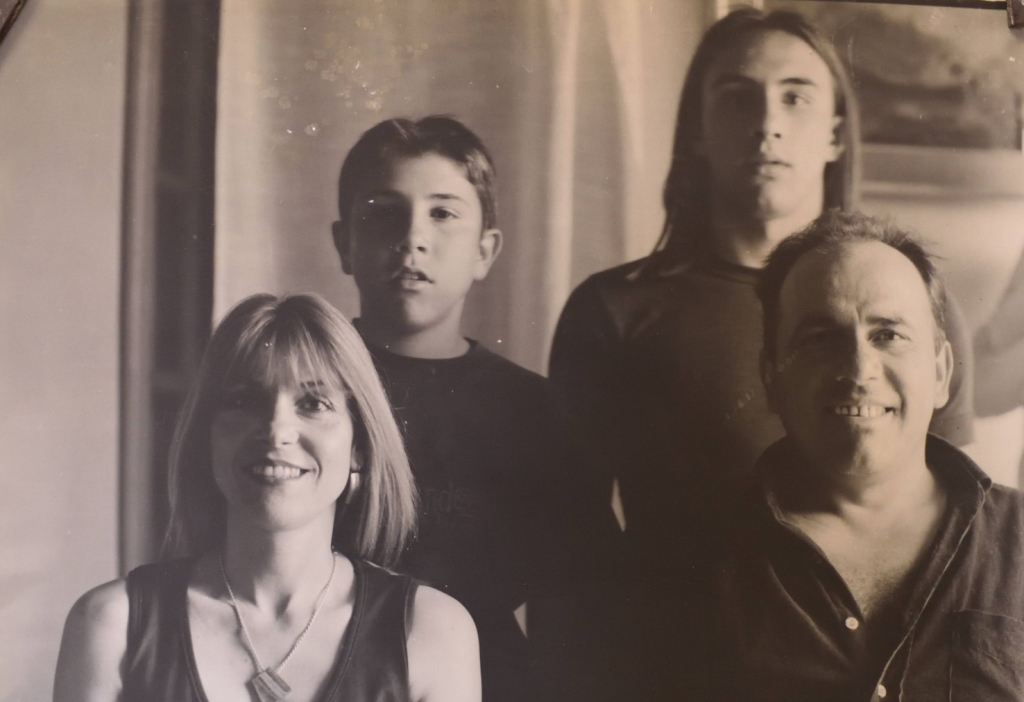
©Danae Kaplanid, PIOP (2023). Hondrogiannis family photo.
During our discussion about the profession of a marble carver today and what it entails, the intellectual division of art and craft arose.
While Dimitris notes that they make ‘art’ every day, even when carving custom orders, Yiannis feels that he makes ‘art’ when he carves a free design of his inspiration.
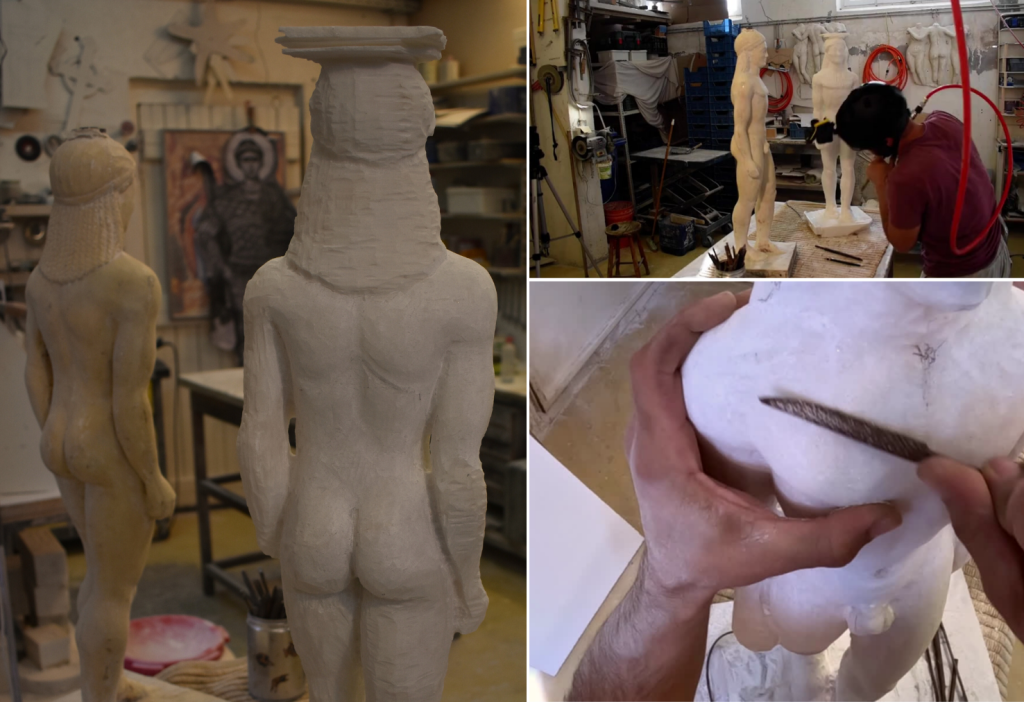
©Danae Kaplanid, PIOP (2023). Hondrogiannis workshop sculptures and Yiannis while working. Gavriela Senteri, ARMINES (2023). First-person view of Yiannis wokring.
It should be reminded that the words ‘art’ and ‘craft’ are the same word in Greek, techni. Thus, marble carving in Greek is marmarotechnia, literally translated as ‘marble art’. Consequently, the distinction between art and craft must be established beforehand. In our case, we suggested the distinction between utilitarian and non-utilitarian objects, but the participants disagreed. For them, it seems that craft relates to the manual work and art to the intellectual, that is, the process of “leaving your mind free to create a sculpture”, as Yiannis notes. Apparently he feels a deeper emotional and personal connection to his creations, while Dimitris practices crafts typically and enjoys the process as something more practical, as if creating for the satisfaction of skill or functionality.
Yiannis’ artworks are available for sale at their gallery shop in Pyrgos, but as the brothers mention, they are more difficult to sell. People usually prefer to buy smaller objects that reveal their handmade nature, such as uneven shot glasses.




6 responses
I was also wondering if I could share an image directly by using HTML, line
Yes, now you can. Please go ahead and try