
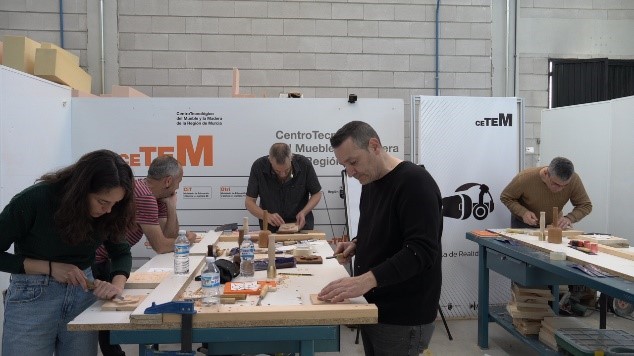
Traditional crafts are often learned through observation, repetition, and guided practice. But what happens when that learning is expanded with digital tools? At CETEM, within the CRAEFT project, this question shaped a pilot experience focused on woodcarving, combining face-to-face training, online learning, and a hybrid model to explore how traditional knowledge can be taught, reinforced, and sustained in new ways.
An experiment designed to preserve and teach craft knowledge
This experiment was created to introduce participants to the basic principles and techniques of woodcarving while also testing the value of digital materials, especially interactive videos and online modules, as support for learning and long-term practice. The initiative did not limit itself to technical training. It also aimed to strengthen appreciation of woodcarving as part of Yecla’s local heritage and to build a replicable educational framework for traditional crafts.
Participants were expected to acquire manual, artistic, and cultural skills: from tool handling and safety to finishing techniques, from identifying suitable woods to understanding the historical relevance of woodcarving in Yecla and its connection with furniture making.
Three ways of learning the same craft
CETEM structured the experiment around three training formats. One group followed traditional face-to-face sessions with direct instructor guidance. Another completed the course entirely online through the CRAEFT e-learning platform. A third group combined both approaches, starting with in-person practice and continuing online to reinforce what they had learned.
This design made it possible to compare not only knowledge acquisition, but also the learning experience itself. The face-to-face course proved especially effective for building confidence, manual dexterity, and artistic sensitivity. The online course worked well for transmitting theoretical and visual knowledge, although it showed clear limitations in areas that depend on tactile experience and immediate correction. The hybrid format emerged as the most balanced model, combining direct practice with the possibility of reviewing content at one’s own pace.
Experiment conclusions
The experiment confirmed something that many craftspeople already know intuitively: manual skills are difficult to teach without physical practice, but digital tools can play a meaningful supporting role. Participants in the face-to-face course valued the direct interaction with the instructor, the opportunity to observe others, and the progressive structure of the exercises. Online learners appreciated the clarity of the videos and explanations, especially for identifying tools, understanding materials, and following the logic of the carving process.
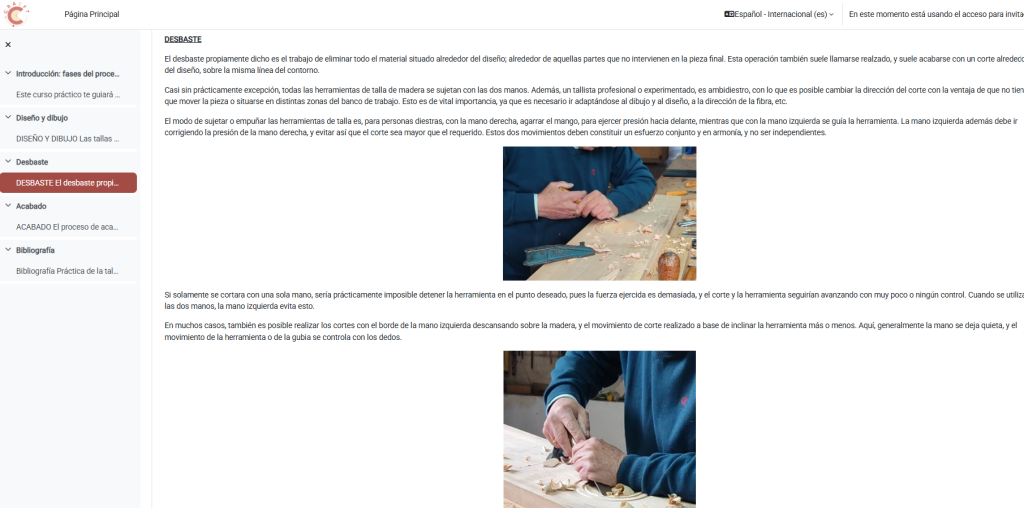
Figure 1. Screenshot of the online training on woodcarving. © CETEM
The hybrid learners offered perhaps the most interesting perspective. They saw the in-person training as essential for understanding tool handling and safety, while the online materials helped them revisit specific techniques, reflect on the process, and continue learning independently. CETEM’s evaluation therefore points toward blended learning as a promising path for craft education, not as a replacement for workshop learning, but as a way to extend and strengthen it.
Beyond the experiment
One of the most valuable outcomes is that the course materials did not remain locked inside the experiment. Following the positive results, the online course was revised, especially in relation to workshop safety, and integrated into CETEM’s training catalogue. The course was also promoted through the ALLVIEW platform, extending its reach beyond the immediate pilot and opening new opportunities for vocational education and lifelong learning in traditional crafts.
This is where CETEM’s role becomes especially relevant. The centre is not only documenting traditional woodcarving. It is actively testing how that knowledge can be preserved, taught, adapted, and shared with new audiences, from VET students to professionals and adult learners.
Topics for discussion
- How can hybrid learning models strengthen the transmission of traditional craft skills?
- Which elements of woodcarving can be effectively taught online, and which still require direct supervision?
- How can vocational training centres make traditional crafts more attractive to new learners?
- What does CETEM’s experiment suggest about the future of digital support in heritage-based education?