
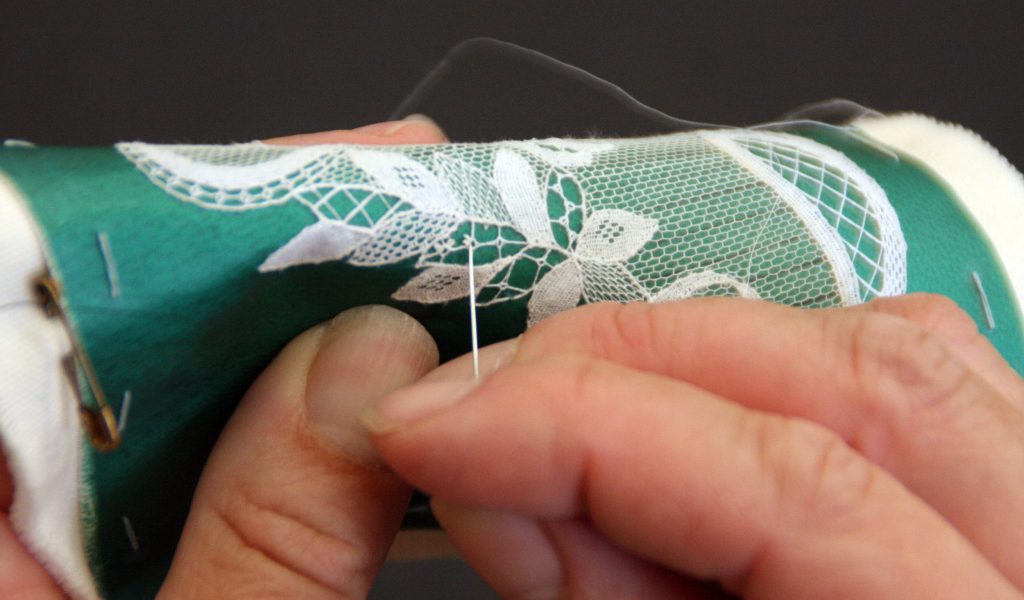
Alençon lace is a region-specific form of needle lace, handmade in the town of Alençon in Normandy, France. Known for its delicate and precise patterns, it has been a symbol of French luxury and craftsmanship since the 17th century. Crafted with fine needles and linen thread, the technique involves a multi-step process passed down through generations by oral tradition and repetitive practice.
Recognised by UNESCO as part of the Intangible Cultural Heritage of Humanity, Alençon lace-making continues to be preserved through dedicated workshops, training programmes, and museum collections.
Ten Stages in the Production of Alençon Lace
The production of Alençon lace, an exceptional needle-made technique, includes ten key stages:
Artistic Design:A design with white ink is created for the final design, and then a technical drawing with red ink is made on a piece of drawing paper cut to fit the design.
Piercing:Uniform perforation of the parchment along the outline of the design.
Outline:The basic design (frame of the lace) is drawn on the perforated parchment.
Netting:A uniform and transparent stitch is applied behind the decorative areas.
Filling Stitches:Specific parts of the design are made with stitches placed at varying distances to create shading.
Style:Various decorative patterns are added to the basic design: snowflakes, combs, Venetian patterns, the “O à nez” (a circular motif), the Holy Spirit, mosaics, etc.
Embroidery:Raised work on the outline.
Removal:The lace is removed from the parchment using a razor blade.
Cutting:Thread scraps are removed from the back of the lace that has been detached from the parchment with meticulous care, using a small pin.
Polishing:The filling stitches are pressed cold with a lobster claw nail.
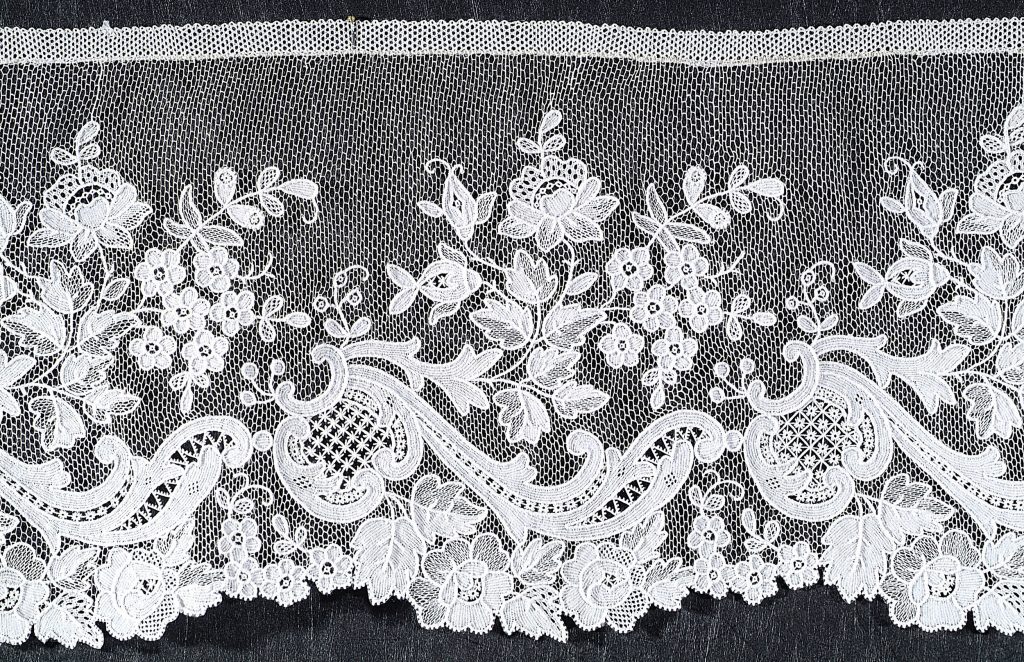
© Gilles Kervella, 2009
The Spread of Lace Art
The transmission of knowledge about the production of Alençon lace occurs exclusively through practical apprenticeship, requiring seven to ten years of training to fully understand the technique.
- The apprenticeship relies on a close relationship between the specialized lace maker and the apprentice, based solely on oral transmission and hands-on teaching.
- The technique cannot be learned through written texts. By the 20th century, the production of Alençon lace was based on a specialization method, where each stage of the production process was handled by a different person. Today, each Alençon lace maker knows how to complete all stages of the process.
Other activities spreading the craft include:
- Educational programs for enthusiasts and professionals in similar techniques.
- Informational actions in schools to cultivate interest in the art of lace-making.
- Publication of catalogs, film production, and exhibitions for the general public.
- Guided tours of lace collections at the Fine Arts and Lace Museum.
- Demonstrations by lace makers from the National Lace Workshop.
- Creation of a website to promote and disseminate the art.
- Scientific and professional meetings.
- The digitization and cataloging of Alençon lace collections also plays an important role in spreading knowledge of the technique and the history of the art.
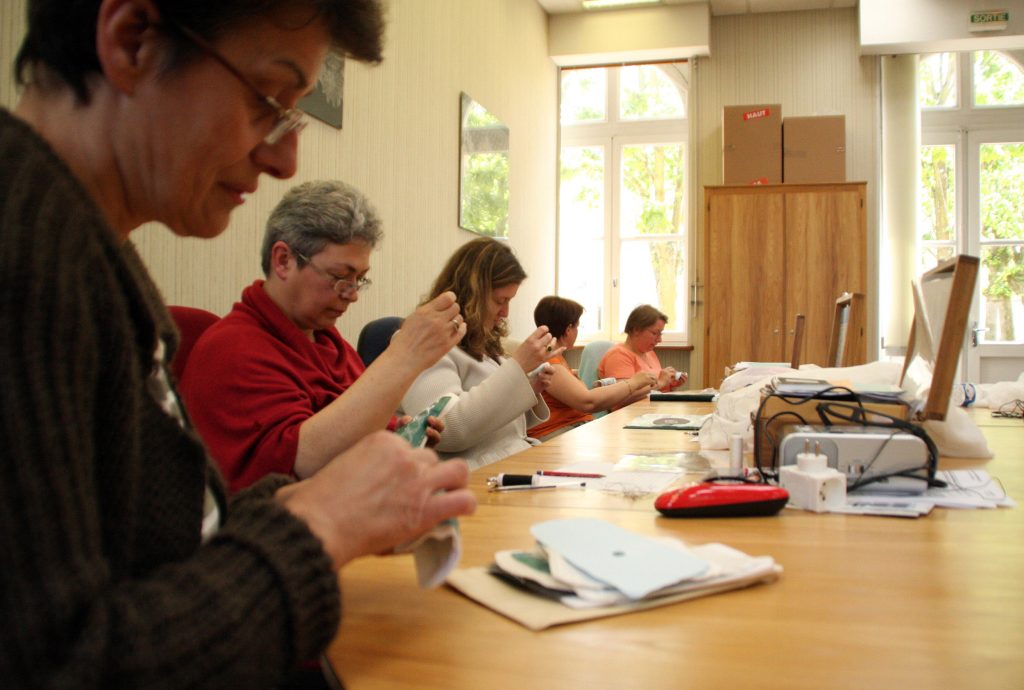
© Sébastien Collet, service communication de la ville d’Alençon
Preservation of Alençon Lace Art
The art of Alençon lacemaking is preserved through a series of measures implemented by various organizations, including the lace makers themselves, the city of Alençon, and the French state.
National Lace Workshop of Alençon: Established in 1976 with the aim of preserving the technique, which was at risk of disappearing. The lace makers working at the workshop are tasked with maintaining, rediscovering, and transmitting their knowledge. This is achieved through reproducing designs, researching forgotten techniques, and adapting the designs of contemporary artists.
Training New Lace Makers: Continuous training of new apprentices is a critical factor in ensuring the transmission of the art. The French state planned to hire one or two apprentices by 2012. Alençon lace makers are committed to training new apprentices and participating in the training of educators who will teach the public and schools.
Lace Collections & Museum: The city of Alençon maintains significant lace collections at the Fine Arts and Lace Museum. There is an ongoing policy to enrich the collection, and efforts have been made to catalog and digitize this material. This work strengthens the relationship between the National Lace Workshop and the museum. The city of Alençon is committed to continuing the acquisition of lace collections, including contemporary creations, and ensuring these collections are well-preserved and available for study. Additionally, the city is committed to renovating the permanent exhibition space for lace.
Dissemination & Promotion: Responsible organizations have developed activities to spread Alençon lace, including:
- Organizing biennial exhibitions by the museum.
- Regular publication of catalogs.
- Film production.
- Guided tours of the collections.
- Demonstrations by lace makers from the National Workshop.
- Creation of toolkits for schools.
- Designing urban features inspired by lace.
- Involvement of cultural institutions, such as the National Theater of Alençon.
The city of Alençon is also committed to organizing events to promote lace to residents and visitors and supporting the development of a center for public and professional education. Additionally, it plans to create a website for the promotion and dissemination of the art.
Community Involvement:The submission of Alençon lace’s candidacy for inclusion in the UNESCO Intangible Cultural Heritage List involved the participation of lace makers and the city of Alençon. This involvement is crucial for ensuring the sustainability of the art. The city of Alençon is committed to strengthening the presence of the National Lace Workshop in the city.
Commitment of the French State:France, through the General Administrative Unit for the Mobilier National and the Gobelins, Beauvais, and Savonnerie factories, which oversee the National Lace Workshop, is committed to:
- Maintaining the number of lace makers in the workshop.
- Supporting lace production through orders.
- Facilitating the integration of contemporary art with Alençon lace.
- Providing financial support to museums for the lace collection.
Registration on the UNESCO Intangible Heritage List:The registration of Alençon lace on the UNESCO Intangible Cultural Heritage List is an important step for the recognition and promotion of this rare art.

2 responses