
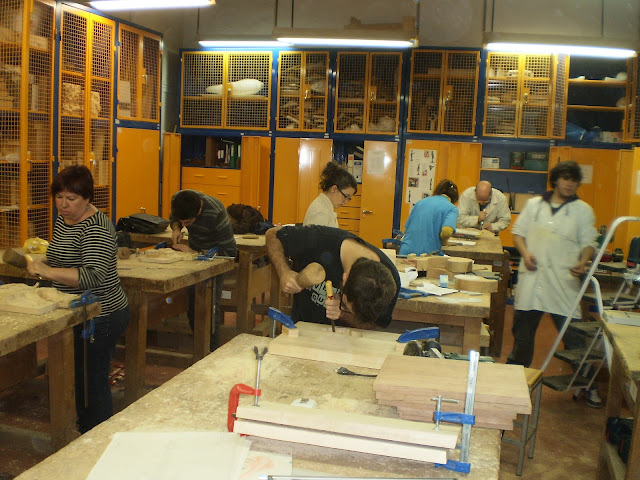
Woodcarving, as both a craft and an artistic expression, has deep cultural and historical roots in Spain. From ornamental furniture to religious sculptures, its legacy continues to shape the aesthetic and identity of many regions. Today, the transmission of this knowledge spans both formal academic institutions and non-formal workshops and courses. This post explores the current landscape of woodcarving education in Spain, from university degrees to local craft training centers.
University programs: art meets tradition
Several Spanish universities include woodcarving as part of broader Fine Arts or Cultural Heritage programs:
- University of La Laguna: Offers a specific course titled “Wood Sculpture Carving” within the Fine Arts degree. View course
- Complutense University of Madrid (UCM): Includes woodcarving techniques in the course “ Processes and Procedures of Sculpture”. Course PDF
- University of Zaragoza: The course “ Sculpture Workshop” touches on woodcarving as a traditional sculptural practice. Guide
- University of Murcia: The subject “ Sculptural Techniques I” includes practical elements relevant to wood sculpture. Guide
Additionally, degrees in Conservation and Restoration of Cultural Heritage include wood sculpture topics:
- University of La Laguna: Course in Conservation and Restoration of Sculpture. View
- Escuela Superior de Conservación y Restauración de Bienes Culturales de Aragón: Includes Sculptural Techniques focused on traditional materials and methods. Course info
As we can see, woodcarving is taught across several Spanish universities through both Fine Arts and Conservation programs, each offering a unique perspective. Fine Arts degrees (e.g., at La Laguna, Complutense, Zaragoza, and Murcia) approach woodcarving as a subtractive sculptural technique, emphasizing hands-on learning with tools, materials, safety, and both traditional and contemporary artistic practices. Students engage in exercises ranging from basic carving and assembly to conceptual sculpture, often linked to modern and historical art movements.
In contrast, conservation and restoration programs (such as those at La Laguna and the School of Conservation in Aragón) focus on wood as a historical support material. These courses explore wood anatomy, traditional joinery, and restoration methods for polychrome sculptures, highlighting preservation techniques and ethical considerations. Together, these programs demonstrate how woodcarving remains a vital skill in both artistic creation and cultural heritage preservation.
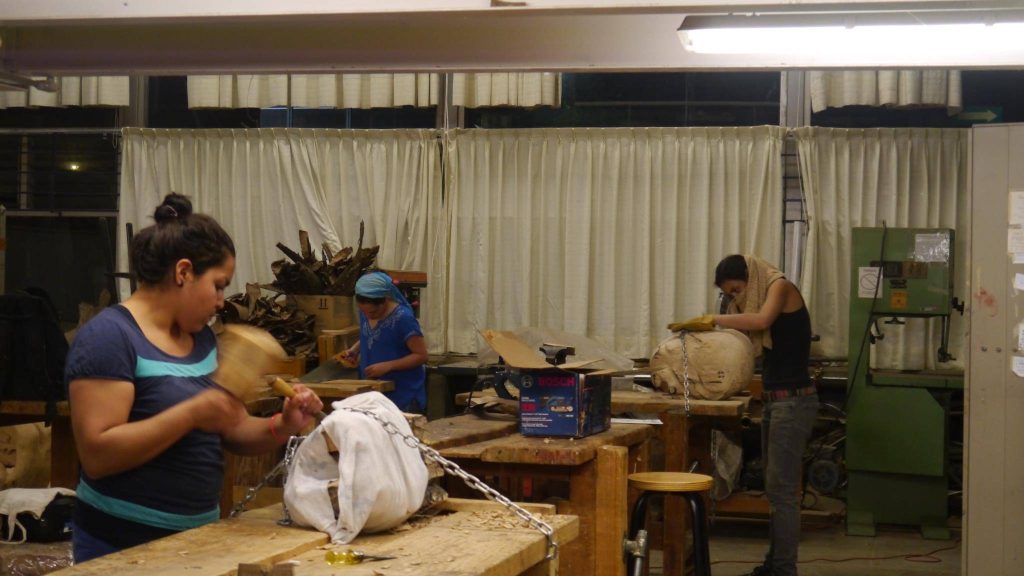
Advanced vocational training: specialization in woodcarving
The Spanish education system offers Advanced Vocational Training Programs (Ciclos Formativos de Grado Superior) specializing in Wood Sculptural Techniques. Students are trained to design and create sculptural, ornamental, and decorative works, both from original concepts and commissioned projects. The program emphasizes planning, material knowledge, technical execution, and quality control, ensuring that graduates are equipped to carry out every stage of the sculptural process. More info
Key institutions offering this training include:
- Escuela de Arte de Murcia
- Escola Massana (Barcelona)
- Escola d’Art i Superior de Disseny (Barcelona)
- Escuela de Arte y Superior de Diseño de Córdoba, Huelva, Málaga, Zamora, Madrid (La Palma), A Coruña (Pablo Picasso), Burgos, and others.
Intermediate vocational training: reproduction techniques
Grado Medio programs such as Artistic Reproduction in Wood focus on traditional reproduction methods, use of tools, and material experimentation. This training emphasizes both traditional and contemporary techniques, tools, and materials, integrating manual craftsmanship with modern technologies. The program also prioritizes safety, occupational health, and environmental protection throughout the production process, ensuring high-quality outcomes. Graduates are equipped to pursue careers such as wood sculptors, decorative woodcarvers, frame and molding carvers, and processors of wood. More info.
Schools include:
- Escuela de Arte Pancho Lasso (Lanzarote)
- Escuela de Arte José Val del Omar (Granada)
- Escola d’Arts Llotja (Barcelona)
- Escuela de Arte León Ortega (Huelva)
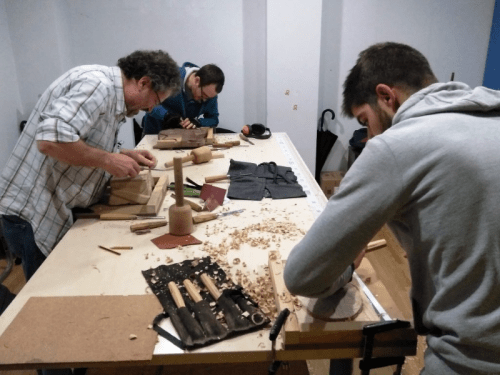
Non-formal and professional training: keeping the craft alive
Outside the official educational system, a rich network of private institutions, workshops, and foundations offer practical training in woodcarving. These range from introductory courses to advanced sculptural techniques.
Examples include:
- INAfe: Decorative Elements Crafting
- Aula 10 Formación: Decorative Woodcarving
- ilexTalla. Woodcarving courses for all levels.
- Escultores Clavero: Introduction to Woodcarving
These offerings provide valuable alternatives for those interested in acquiring or improving hands-on skills, often tailored for specific contexts such as furniture restoration, artistic sculpture, or heritage conservation.
Conclusion: a fragmented but rich landscape
The current state of woodcarving education in Spain reveals a wide range of options, though often dispersed and highly dependent on local initiatives. University programs anchor the discipline in theoretical and historical contexts, while vocational and non-formal education maintain its practical essence. Together, they reflect a hybrid system that preserves tradition while adapting to contemporary needs.
There is still a need to map out the continuity and connection between these pathways, how does one move from non-formal training to formal recognition? Are there bridges between craftsmanship and academic research?
Importantly, documenting and teaching traditional crafts like woodcarving is not just about safeguarding technical skills, it’s about preserving a form of cultural expression that holds meaning, memory, and identity. In a rapidly changing world, such documentation offers future generations the tools to reinterpret heritage in sustainable and innovative ways.
Let’s Open the Conversation
- How do you think formal education can contribute to keeping traditional woodcarving techniques alive?
- What role should schools and training centers play in passing down artisanal knowledge to future generations?
- Can combining traditional craftsmanship with modern educational methods help preserve and innovate heritage crafts? How?

One Response