

Traditional Wall-Carpet Weaving in Romania and the Republic of Moldova is an old craft practised mainly in rural areas. Using vertical or horizontal looms, artisans weave wool into richly patterned carpets called “scoarță.” The process involves preparing the warp and weft threads and using techniques like tight weaving, the karamani method, and curved weaving to create mostly geometric designs by hand.
Traditionally, carpet weaving was done by women, who passed their skills down through families, often as part of a girl’s dowry. Other specialists, such as loom makers and dyers, supported the craft. Today, knowledge is still shared within families but also through weaving schools, workshops, and cultural groups.
These carpets are more than decoration; they carry cultural meaning, mark important life events like weddings and funerals, and help strengthen community bonds. The inclusion of this craft on UNESCO’s Intangible Cultural Heritage list raises awareness worldwide, supports the craft’s survival, and encourages cultural exchange between regions.
Efforts to keep the tradition alive include museum collections, school programs, exhibitions, family associations, and online promotion. This ensures that wall-carpet weaving remains a vital part of Romania’s and Moldova’s cultural heritage.
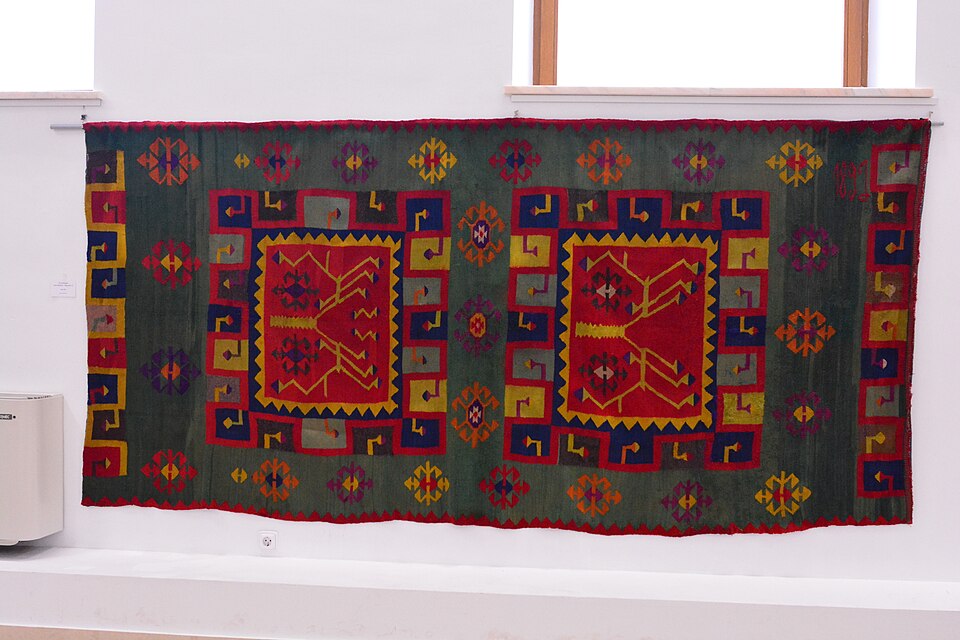
Detail, carpet from Moldova, probably Basarabia, 1892, height: 160 cm (62.9 in); width: 260 cm (102.3 in) (2024, September 13). Photo by Joe Mabel. Available at: https://commons.wikimedia.org/wiki/File:Carpet,_Moldova_(probably_Basarabia),_1892.jpg
Methods of Transmission of the Art of Carpet Weaving
The knowledge and skills related to the art of carpet weaving are transmitted today through various methods:
- Family Tradition:In rural areas, the art is passed down from generation to generation. Daughters learn from a young age alongside their mothers or grandmothers, gradually adopting the tradition.
- Carpet Weaving Centers:In certain cities, craft centers and family associations operate, where younger generations can learn the techniques of carpet weaving.
- Education:In schools located in carpet weaving centers, the techniques are taught in technological education courses and extracurricular programs. Young people learn skills from experienced artisans in cultural centers and museums. The transmission also takes place in art schools for children, cultural spaces, and art academies.
- Publications:Today’s artisans have easier access to carpet weaving knowledge thanks to the publication of books that provide abundant sources of inspiration and information.
- Exhibitions:To encourage the youth, their creations are displayed in exhibitions and fairs alongside works from recognized artisans and objects from family or museum collections.
- Replicating Old Carpets:After 1990, fine arts students participated in replicating designs from old carpets found in ethnographic or private museum collections in Romania and the Republic of Moldova, making them accessible to weavers.
In summary, the transmission of the art of carpet weaving occurs through family, specialized centers, educational institutions, publications, exhibitions, and the study of old carpets.


One Response