
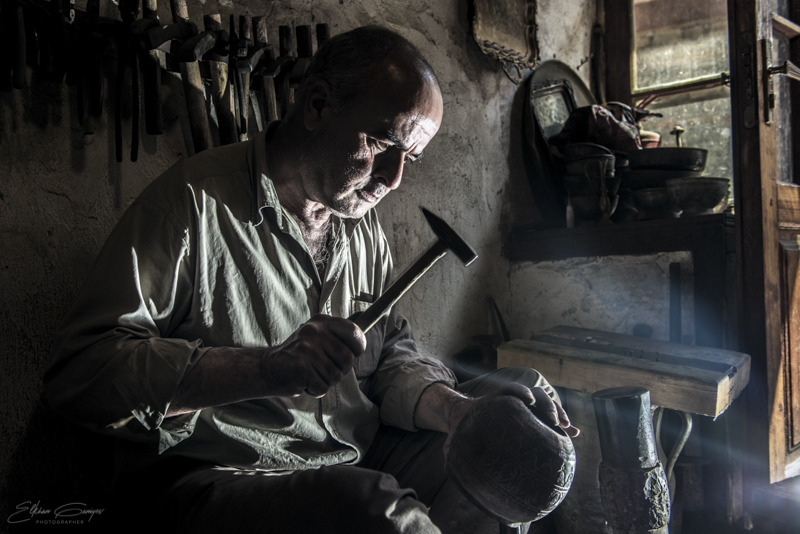
The Copper Craftsmanship of Lahij is a remarkable example of living heritage, where traditional crafts skills continue to shape both objects and identity. Practiced in the mountain village of Lahij in Azerbaijan, this tradition centres on the creation of handcrafted copperware that ranges from practical household items to decorative pieces. Passed down through generations, the knowledge and techniques of hammering, engraving, and casting are preserved through direct apprenticeship and community life, making this craft a vibrant cultural symbol and community pride.
Proposed Methods for the Preservation of Copper Craftsmanship in Lahij
The sources describe a series of measures proposed for the preservation of copper craftsmanship in Lahij, which can be categorized as follows:
Measures for safeguarding and transmission:
- Establishment of a copper workers’ association in Lahij: The goal is to systematize and synchronize the community’s efforts to safeguard all aspects of the art, particularly in terms of enhancing the transmission of traditional methods, ensuring a sufficient workforce, and providing training to the youth.
- Low-interest loans: Loans will be provided to young artisans for opening new workshops, on the condition that they use them as their main workspace and fairly compensate artisans from other subgroups (e.g., blacksmiths, decorators).
- Incorporating a course on the use of traditional copper utensils: The course will be integrated into specialized secondary and higher educational institutions that deal with traditional cooking in Azerbaijan, including presentations, visits to Lahij, and meetings with artisans.
Research and documentation: Graduate research projects: These will study the methodology of copper processing and decoration applied by different families of artisans in Lahij, and will be funded by the National Academy of Sciences of Azerbaijan.
Awareness: Creation of a website, production of audiovisual materials, and publication of brochures: The goal is to inform the public about the social and cultural functions of copper craftsmanship.
Sustainable recycling: Establishment of a collection center for old copper utensils: The center will handle the recycling of utensils for melting and the fair distribution of copper to artisans, reducing their dependence on the raw material market.
Monitoring results: Formation of a special committee: The committee will evaluate the effectiveness of the proposed measures, meet biannually, and submit reports.
The implementation of these measures will involve government bodies, the Ministry of Culture and Tourism, the community of copper workers, and NGOs.
A key element for the success of the measures is the active participation of the copperworking community. The proposals have been shaped based on the needs and priorities of the artisans, who will play a central role in their implementation.
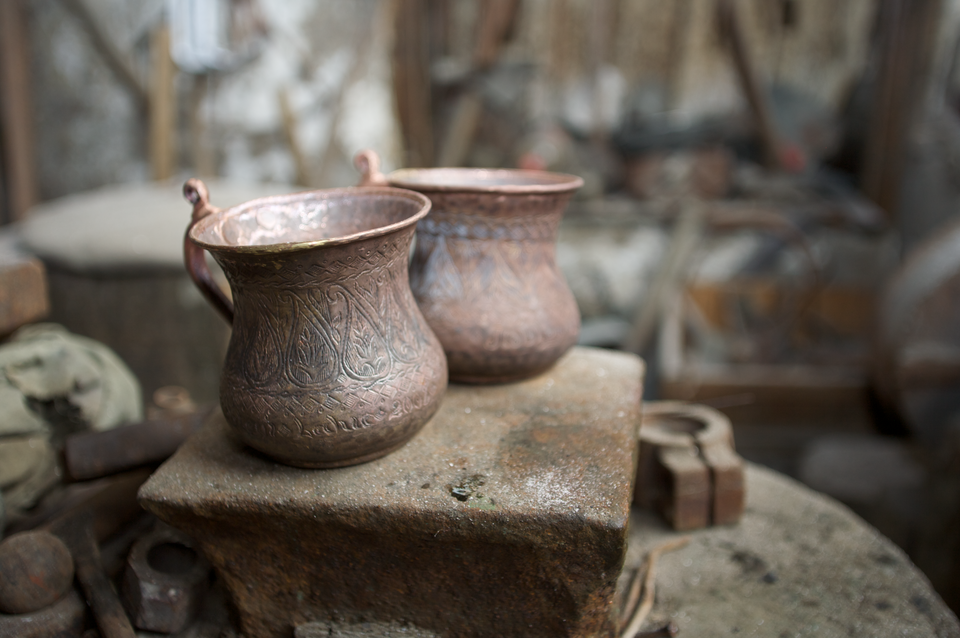
Handwork coppery in Lahic, Azerbaijan (2018, April 19). Photo by Nick Taylor, indigoprime’s photostream. Available at: https://commons.wikimedia.org/wiki/File:Lahic_folk_art.png
Transmission of Copper Craftsmanship Knowledge in Lahij
The knowledge of copper craftsmanship in Lahij is mainly transmitted through informal apprenticeship within artisan families, from father to son. This practice strengthens intergenerational bonds and ensures the continuity of the art.
- Apprentices (mister shagirdi) carefully observe the movements of experienced artisans, memorize the materials, techniques, and tools used, and, finally, experiment under the guidance of the master craftsman (misger).
- Apprentices learning the art of copper melting are intended to become future artisans themselves and are taught not only traditional techniques but also how to manage the family workshop (misgerkhana). The knowledge of the properties and uses of copper utensils is also passed down from generation to generation, from parents to children. For example, there is a tradition of offering a set of copper utensils to daughters getting married, as a wish for health and happiness in their marriage.
Moreover, the Lahij community shows respect for the artisans, whom they consider the protectors of the Prophet Idris.
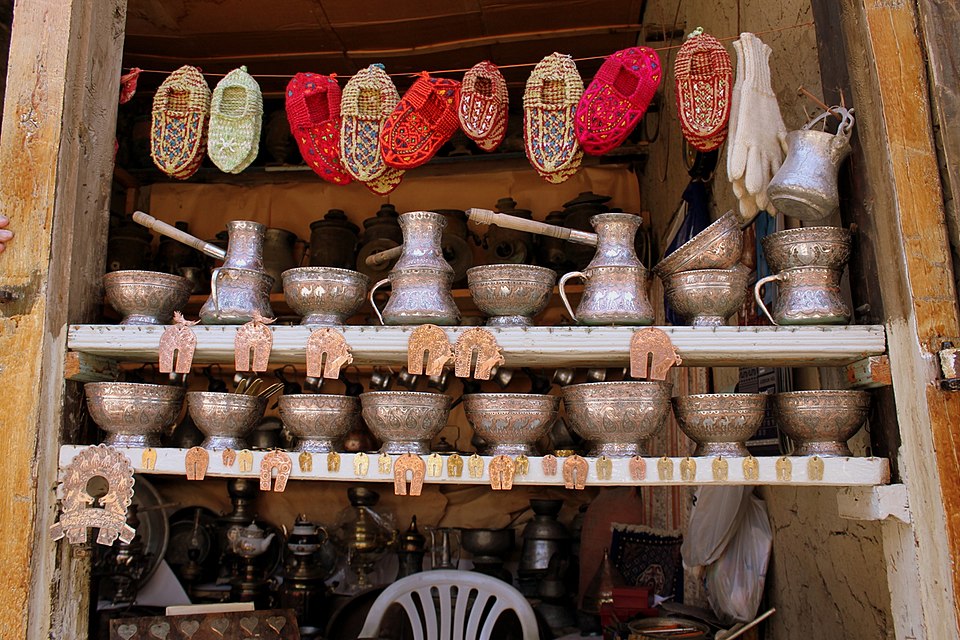
Lahic, Azerbaijan (2010, July 11). Photo by Gulustan. Available at: https://commons.wikimedia.org/wiki/File:%D0%98%D0%B7%D0%BE%D0%B1%D1%80%D0%B0%D0%B6%D0%B5%D0%BD%D0%B8%D0%B5_1211.jpg
Preservation and Transmission of Lahij Folk Copper Art
The folk copper art of Lahij is preserved and transmitted to the younger generations primarily through family tradition. The skills and knowledge related to the production of copper utensils are passed down from father to son, thereby strengthening the bonds between generations.
- The transmission takes place through informal apprenticeship, where apprentices observe the movements of the artisan, memorize the materials and techniques, and experiment under his supervision.
- Apprentices of copper artisans (misger), who lead the entire process, are considered future artisans and are taught not only the application of traditional materials and techniques but also how to manage the family copper workshop in the future.
- Knowledge about the functions, purposes, and properties of traditional copper utensils is passed down from parents to children.
- According to an old tradition, daughters getting married receive a set of copper utensils with intricate decorative designs as a wish for health and happiness in their marriage. The demand for copper utensils from families in Azerbaijan is considered the main driving force for the sustainability and transmission of the art.
- Many believe that copper utensils have therapeutic properties and prefer traditional utensils over industrial ones.
- Some families keep copper utensils as a family treasure and only serve with them on special occasions.
- The quantity and aesthetic quality of copper utensils in a home are considered indicators of the family’s economic prosperity.
The Azerbaijani government has taken measures for the preservation of the art, such as:
- Granting special state historical and cultural sanctuary status to Lahij.
- Legal framework for safeguarding and promoting the material and intangible heritage of the Lahij population.
- Projects for the development of copperworking, such as exemption from licensing fees and income taxes for artisans.
- Restoration of property rights over copper workshops to the families.
- A state program to safeguard intangible heritage.
In addition to family traditions and state support, the Lahij community has taken initiatives for the preservation of the art, such as the creation of artisan associations and the organization of educational programs.
Overall, the folk copper art of Lahij is preserved and transmitted to the younger generations thanks to the dedication of the artisans, the support of the community, and state protection.
